Sunday, April 24, 2011

Little House in the Big Woods

In my one-woman survey of modern American literature, I have two primary goals that shape my reading selections. One is to read "classics" (as determined by myself, my impressions of pop culture, or top-100 lists) that I haven't read yet but still deem to be generally important in 20th century American life. The other is to revisit works I enjoyed as a child, books aimed at a younger audience, but ones that seem to have withstood the test of time. Again, I'm looking more to re-read books that I enjoyed immensely and are also considered classics; likewise, I'm not planning on re-reading The Babysitters' Club anytime soon.

On that note, I decided to go back through the Little House on the Prairie books, in order, starting with Little House in the Big Woods. I remember reading them in probably the 2nd or 3rd grade, and pretty much every woman to whom I've mentioned that I'm reading these books now has a similar memory. I was extremely interested to see how these characters hold up, now that I'm an adult.

And these books are wonderful. They are very well written, and it's astounding to think of the changes that Laura Ingalls Wilder experienced in her life. She was born February 7, 1867; she is five years old in the first book, so it takes place in around 1872. The first book spans a whole year, as she describes the passage of time in a little cabin in the Wisconsin woods. After she reached adulthood, she surely must have realized how her story represents many old ways that no longer exist, and for that I am grateful that she decided to tell her story.


I was struck by the many differences in their day-to-day life. Laura and her older sister Mary each had one dress. Pa worked all summer, threshing grain by hand so that they would be able to eat over the winter. In the fall, he would hunt and hunt and they would spend days salting and preserving the meat, again so they would be able to eat. She describes these events lovingly; in her childlike way, she never knows how relatively little they have, and it certainly never seems like it. Theirs was a house of love.

In winter, they can still have butter, although the milk from their cow isn't as good, and the butter is white instead of yellow (I never knew this before!), but "Ma liked to have pretty things," so Laura describes a process by which her mother steeps carrots and strains them through a cloth so that the butter will be dyed yellow. Laura, as narrator, explains these acts matter-of-factly. I was continually impressed by the length of time it took them to do many things, but it never seemed to bother them.

In one chapter, she helps her father make bullets by hand, and he shows the lengthy process by which he subsequently loads the gun. After the corn harvest, they make one kind of sweet corn by soaking and boiling it for three days. At the end of winter, when the maple syrup starts running in the trees, they have a grand celebration for the last tapping. The women boil the sap into syrup, and the syrup boils down into all manner of special sweets - sweets that they get to enjoy just once a year. The success of the maple sugar affects how much money they have to spend later in the year to buy "store sugar." Just think - even buying sugar in a store was unheard of. Also in this book, Laura sees a town for the first time, Pepin, Wisconsin. Located on the far western edge of Wisconsin, even today it has about 580 residents.

I could go on and on, relaying these facts I learned about her young life!

The other thing I enjoyed most about this book was the creation of the characters. In some other books I've read recently (Tropic of Cancer(1934) by Henry Miller comes to mind) where the narrator and author were one, all too often those roles get confused. It's easy for the author to lose track of the character and often haphazardly inject themselves at will.

Here, though, Laura-the-writer does a seamless job of creating Laura-the-character. Her five-year-old spirit shines through, and the characters of her sisters and parents, too, are deeply developed. It helps, certainly, that they are based on real people, but the trick with fiction is in crafting believable, endearing characters. The narration is clear, almost as a five-year-old would describe things; I can almost her the ring of her voice and the peal of their laughter. Even though the words are simple, I can feel the warmth of Pa's fiddle singing them to sleep on winter nights, all tucked together in their little cabin.

Wednesday, April 13, 2011

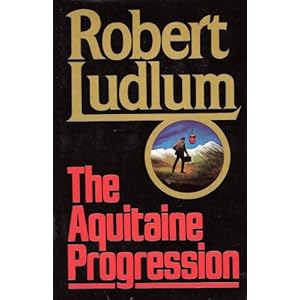
The Aquitaine Progression


Okay, so I lied. My first post will be about the most recent book I've read.

The Aquitaine Progression is an espionage adventure novel that unfolds in a way very typical of Robert Ludlum. That's good, because he wrote it.

Ludlum is best known in popular culture for penning the Bourne novels, three of which were made into a action-packed motion pictures starring Matt Damon. The series was continued in that spirit after his 2001 death; I haven't read any of them yet, so it's not entirely relevant here, but he is one of my favorite authors regardless. Ludlum can spin a spy tale with the best of 'em, and often while reading his books I find myself on the edge of my seat.

Ludlum's stories often involve some sort of thrilling conspiracy, and that is very much the case in this mighty tome. The Aquitaine Progression follows Joel Converse, an American lawyer. A childhood friend mysteriously appears to give him the inside story of a rising global network of dangerous, disaffected, powerful old generals who are hatching a plan to take over the world with chaos of every form. Joel is recruited as the sole emissary to stop them.

Over the next five hundred pages, Joel hurtles through Europe. At every turn, the network of the gentlemen of Aquitaine appears. Joel has to work his way as close to these conspirators as possible so as to hopefully figure out how to stop them before they use their vast web of power to topple governments worldwide. Once the governments are toppled, these men will be readily able to step in and impose their own personal brands of authoritarian rule.

Honestly, the book took a while to get going. Ludlum takes his time developing the character of Joel. I was grateful for this, for I have a clear picture in my mind of who this man is. Nonetheless, by about 200 pages I was unsure if the action would ever pick up. It certainly did, though, and eventually I devoured page after page.

Once the generals realize that Joel is on to them, they use their many contacts around Europe to paint him as a ruthless assassin - almost entirely for crimes committed, in fact, by his enemies. A manhunt rages on the continent, and for days Joel can think of nothing other than his own survival, let alone the unraveling of this organization that is his primary goal. Every time he thinks he is safe, or has found a person he can trust, he finds more scouts of the Aquitaine generals. More than once, he encounters a friendly acquaintance from the past and feels safe, only to find that they, too, are in the clutches of this powerthirsty bunch.

His adventures, like many in Ludlum's books, were gripping, certainly. I had difficulty dealing with the hopelessness which pervaded the bulk of the book. It's the stuff of nightmares - nowhere to run, nowhere to hide, nobody to trust. Almost without exception, every old friend Joel reached out to that provided him with even the slightest olive branch of help was subsequently killed by agents of Aquitaine.

Most of the book passes with our protagonist on the run in Europe, always barely one step ahead. This book was written in the 1980s, when we were still technically fighting the Cold War, and more than anything it demonstrates the insecurities present in the U.S. since its inception. Joel is an ex-POW from Vietnam, and that inextricably pervades his character's worldview.

The eleventh hour approaches. Aquitaine is in days of launching their plan for total global domination. Joel's list of friends who are alive dwindles. Throughout this ordeal, he doesn't know who in the U.S. government actually dispatched him for that, too, is kept secret. He has had sporadic contact with his ex-wife, a freelance artist living along the Massachusetts coastline; somehow, she continues to elude Aquitaine, and in fact she decides to come to Joel's aid in Europe.

Somehow, in the last few chapters of the book, everything comes together. Joel is able to thwart the world takeover and sees to it that the generals will not be in charge of any such conspiracy again. He achieves this, in large part, through recruiting agents worldwide who are willing to stand up against these terrifying powers. This filled me with hope, though I was left wondering where he found these soldiers, and why they were so impossible to find throughout the majority of the book.

Additionally, the drama concludes within a relatively short space. I felt a little bit disappointed that it was all over so quickly - after working my way through several hundred pages, the least I could ask for was a prolonged denouement. I felt that it all wrapped up just a tad too nicely in the end; however, Joel certainly suffered enough in the previous pages, so I suppose I should be happy for him that things finally worked out the way he wanted. He was a savvy and enjoyable character, so for that I'm grateful to have spent so many pages bonding with him.

This was not the first Ludlum novel I've read, nor will it be my last. I would recommend a few other works above this one, but nonetheless I would recommend it to any reader who enjoys a complicated spy novel with plenty of fighting, car chases, and disguises.

The Aquitaine Progression by Robert Ludlum - 1984

Other works by Ludlum I enjoy:
The Matarese Circle (1983)
The Matarese Countdown (1998)
The Scarlatti Inheritance (1971)

How many blogs does it take?

Before a person is considered a Blogger with a capital B?

Well, now I have two. This blog is about all the books I read.

This winter and spring have been an adventure in reading for me, as well as the many adventures through the heartland and through my heart which I depict right over here.

In this blog, I will write synopses and reflections on the books I've read over the past several months. Hopefully, I will catch up to the present and reflect on the books I'm currently reading. If nothing else, this will provide an outlet for the scribbled notes strewn around my apartment, scrawled in a fit of inspiration while reading one tome or another.

Enjoy!